
How often do you find yourself watching a series or film about horse racing? Even though horse racing is considered to be one of the most ancient of all sports, I, for one, can’t remember the last instance I sat in front of the TV cheering for a fictional (or real-life, let’s be honest) horse with a funny name and their brave jockey in brightly coloured silks.
That is, I couldn’t remember such an instance until TBS’s uniquely moving Passing the Reins, a 10-episode drama that aired during last year’s Autumn kuru (Oct-Dec) in Japan, arrived on Netflix.
Re-titled “Passing the Reins” since the original “The Royal Family” would understandably lead to the wrong Google search results, the series is based on Hayami Kazumasa’s award-winning novel, The Royal Family. Penned by Kiyasu Kohei and directed by Tsukahara Ayuko, Matsuda Ayato, and Fukawa Ryosuke, the adaptation was produced with the full cooperation of the Japan Racing Association (JRA), which ensured the filming of the most accurate and impressive sequences at actual racing tracks, training farms, and ranches.
Passing the Reins is a horse-racing epic that spans nearly two decades, chronicling the struggles and victories of a horse owner, his family, and his loyal secretary. While the appeal of this story surely lies in the grandeur of the races and the thrill of the competitions, Passing the Reins truly shines in its heartfelt portrayal of resilience, persistence, and human bonds.
This review contains very, very mild spoilers. Read it at your own risk! For our 100% spoiler-free summary, you can find our review pin at the bottom!
An Auspicious Encounter

We first meet tax accountant Kurisu Eiji (Tsumabuki Satoshi) in 2011 as he’s politely scolded by a manager for “losing his will to work” over the past year. But Kurisu is a highly skilled, meticulous professional, which is why, despite his apathetic approach, he’s assigned to a big project with Royal Human, a large temp company. His goal is to investigate their oft-defeated horse-racing division led by Royal Human founder, Sanno Kozo (Sato Koichi), whom his son claims is embezzling funds.
Kurisu then travels to Hokkaido, where he meets Sanno competing for a new racing horse against Soryu CEO Shiina Yoshihiro (Sawamura Ikki) at an auction. Blunt, a tad grumpy, but clearly passionate about the sport, Sanno introduces Kurisu to an intricate world that goes much further than just horses, money, and victories.
Horse racing is a dynamic, bustling reality that Kurisu knows nothing about. As he’s taken from ranch to ranch and witnesses the work of trainers, stable owners, and breeders, Kurisu comes to realise that it’s the collaborative effort of many—their care, hard work, and dedication—that allows a racing horse to compete. Kurisu is soon bewitched, but living up to his reputation, he still conducts a fair and thorough investigation, which does uncover embezzlement of funds by Sanno’s secretary.
This encounter with Royal Human and its horses offers healing for wounds Kurisu has been carrying for quite a while. He then finds purpose and meaning in Sanno’s horse-racing division and accepts his proposal to take over the role of his secretary. Kurisu and Sanno are now partners in crime who share a very clear mission: to make their horses the best in Japan by winning the coveted Arima Kinen, one of the country’s most important races.
We are invited to follow this long quest for a seemingly far-fetched dream through an engaging narrative that constantly subverts our expectations. Passing the Reins knows exactly what kind of story it wants to tell, and it wastes no time on trivial subplots or melodramatic antagonists. This is the tale of a clever and enthusiastic secretary who courageously embraces a challenging goal and creates the means to achieve it.
Passing the Reins: A Tale of Family and Persistence

Kurisu is a powerhouse of a protagonist: he is tenacious, dedicated, and compassionate. He brings people together, helping them find their collective rhythm and harnessing their individual strengths so that, as a group, they become indomitable. To reach the Arima Kinen, Kurisu mends a heart with every episode, allowing the show’s many characters to find their own purpose within his huge dream, which they build with meticulous attention.
Sanno and Kurisu are surrounded by people who make Sanno’s ambition their own. Passing the Reins carefully weaves a tapestry of not only familial ties, but human bonds. “Family” isn’t just about blood in Passing the Reins, but about shared passion. Kurisu offers Sanno a found family that wholeheartedly trusts, cares, and believes in one another. With just a dash of romance and a whole lot of companionship, these characters establish solid and vibrant dynamics that propel the plot forward in the most heartwarming and rewarding ways.
But Passing the Reins is also a story about blood relations and intergenerational conflicts. Motherhood is portrayed with a significant amount of admiration and gratitude, while fatherhood receives a much pricklier depiction. Sanno is a morally grey character: some find him terrible, some love him. To his wife and children, he has always been an absent partner and father. To his colleagues, he has always been a devoted businessman and horse owner instead. Despite his failings, he does care about people—his family included.
The same description could easily be given to CEO Shiina, who Passing the Reins refuses to turn into a classic “antagonist”. Shiina and Sanno have the most complex and interesting of relationships. They are rivals, which is probably why they understand each other better than anyone else. They share the same motivations, they find comfort in each other’s presence, and, most importantly, they hold each other in high regard.
Both Sanno and Shiina are given sons with whom they are bound to go head-to-head. They represent the old against the new, two sides of the same coin that need to learn from each other to achieve their goals. Their similarities and differences allow their children to come to terms with what they have received from their parents while recognising their need to design their own path in life.
What is fascinating about Passing the Reins is that it never romanticises the fact that those men dedicated themselves more to horse racing than to their families, while never turning them into complete villains. The script shows understanding towards both sides and portrays them with the same thoughtfulness.
Family aside, Passing the Reins is a story about believing in yourself and your own dreams, about finding the courage and hope to persist despite the obstacles, fears, and expectations that are imposed on you. These characters’ determination and passion become contagious, and since they care so deeply about each other and their goal, you can’t help but root for them. You naturally care because they care.
Creating Kurisu’s Universe

In order to portray twenty years of events about a topic that most of us aren’t really familiar with, the series makes use of a sort of frame narrative. A narrator guides us through Kurisu’s story, explaining how the business works and deciding what events to show us and which ones to keep offscreen. While time often seems to pass in the blink of an eye, Passing the Reins knows when to slow down, focusing on vital conflicts and accomplishments that define who these characters are.
The series succeeds in stripping horse racing of its money matters, concentrating on a more humane and collaborative aspect of the sport instead. That comes as no surprise since Kurisu is an extremely emotional protagonist, played with huge heart and charisma by Tsumabuki Satoshi. Tsumabuki then builds palpable chemistry with his castmates: he and Sato Koichi are excellent, but it’s also wonderful to see him next to the charming Matsumoto Wakana, who plays his long-time friend Nozaki Kanako, and Meguro Ren as Nakajo Koichi. Actually, Meguro gives a solid and confident performance here, which is very much worth a special mention.
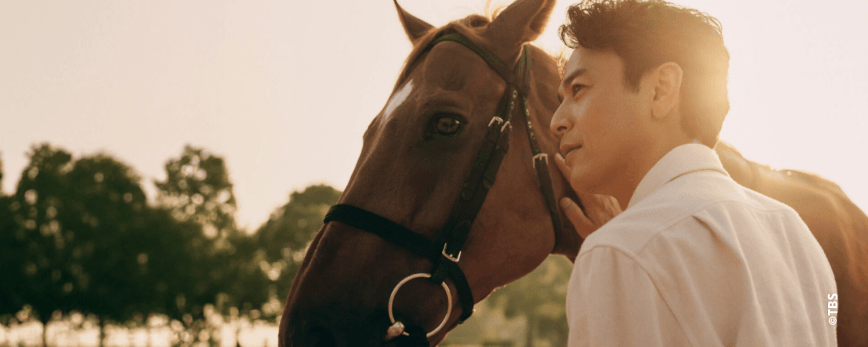
Visually, Passing the Reins is an admirable achievement. Photography makes some lovely use of negative space in more emotionally heavy scenes, while it allows the ranches and their horses to truly shine throughout the series’ run. By combining a single-minded script with some very effective cinematography and mostly well-executed visual effects, the show transforms each and every race into a tense and riveting experience that you share with its characters.
Should You Watch Passing the Reins?
Not exactly an underdog story, but close, Passing the Reins counts on a confident narrative brought to life by a talented cast and some very skilled craftsmanship. While the show throws us into an unfamiliar universe of horses and races that might feel distant to most of us, it keeps us grounded through humane characters and resounding themes that invite us to come back, episode after episode.
As we follow twenty—eventful and fascinating—years of Kurisu’s life, with all its encounters and farewells, its defeats and victories, we’re reminded that perhaps what our wildest dreams truly require is a good dose of patience, courage, and hope.
You can watch Passing the Reins on:


Leave a Reply